Showing posts with label Tidbits. Show all posts

There are Apples and...Apples

It can be tough to pick the right apple for, let's say apple sauce, to bake a pie or to prepare stuffed in the oven. Recipes make it very challenging too because, most of the time, they name a specific type common in some part of the world, but not available at your local store.

That is why when I saw this post in Facebook by Food Inc. I thought I needed to share it. Hopefully it will simplify your cooking life! At least, when it comes to apples...


Summer's Coolest Brew


Most of you already know how I just love Oprah and her O Magazine. In June's issue Jessica Girdwain wrote an article on the different benefits of drinking tea... with a twist. For the longest time, drinking tea was considered 'boring' (not that I cared) or, shall we say, far too 'traditional'.
Things are changing as people are realizing tea is one of the best things you can drink. Its antioxidants compounds have been shown to reduce the risk of cancer and heart disease, specially green tea. It may also help with weight management, if only for the fact that it will keep you away from the fridge!

When you mix it with other beneficial ingredients, Girdwain explains, you can enhance its power to tackle health problems ranging from high blood pressure to an upset stomach.

Even though the article suggests using tea bags, I never do. Once you have tried 'real leaves', believe you me, tea from bags will taste like dirty water and you will never will want to go back to that.

I tried all of O Magazine's tea upgrades and this one is, by far, the best.


Boost your Immunity
Green tea + cranberry juice

Catachins are antioxidants with antiviral properties and are plentiful in green tea, far more than in black. According to a Purdue University study, adding vitamin C -very much abundant in cranberry juice- can increase absorption of the tea's catechins.

Todd Rubin of tea manufacturer The Republic of Tea suggests to steep 2 tea bags (3 grams) of green tea in 250 ml of very hot water (do not let it come to a full boil) for 2 minutes. Once cool, stir 50 ml of unsweetened, organic cranberry juice. Pour over a glass filled with ice.
If you need to sweeten it, stir in a tsp of agave nectar.

Wondering what the other 4 healthy ice tea combinations, published by O Magazine, are like? Check them out!
Enjoy!


The Thing About Juicers

Until recently, I didn't even look at juicers. I eat so much raw vegetables and fruit as it is, that I never felt the need to juice anything. I just had the whole thing!
A few weeks ago my friend Lotty made a glass of juice for me with red beets, some carrot and an apple. I just hate red beets. But since it is so incredibly healthy, I have tried preparing them in many ways in the past. But, no luck. My mom forced me to eat it so many times when I was little, that I think I developed red beet trauma!
The glass of (mainly) red beet she prepared in a matter of seconds was amazing! So, for the sake of red beet, I decided I was going to get a juicer! I engaged on thorough research. I talked to people that have juicers and have been using it for years; I read whatever I could find on internet and magazines on juicers, and I even watched You Tube videos.
I came to the following conclusion: picking the right juicer can be a time consuming task!
First thing you should ask yourself is what you really want. Because smoothies and juices for most people can be worlds apart. But not for everybody....
See for me, I am O.K. with a smoothie, if we are talking fruit. But a vegetable smoothie? Iu! No way José. That is where the juicer comes in. Drinking juice extracted from a vegetable, is a total different ball game!
The bottom line is: you want juice? You need a juicer. You can settle for a smoothie? Then just use your blender.

Masticating vs Centrifugal Juicer

Juicers are produced with two kinds of machines. Some juicers extract the juice by masticating the pulp. 
These kind of juicers are usually slower but they are better at juicing a wider variety of vegetables, fruit and in most cases, wheat grass and nuts.  The squeezing, pressing and extracting is done in a more efficient manner than with the centrifugal juicer. The machine does not heat up as much as a centrifugal juicer does, and so the nutritional benefit of the juice is said to be slightly higher than that of a centrifugal juicer.
If you are not planning to store the juice (I recommend you don't) but rather are going to consume it immediately, then everything I read indicates that the nutritional advantage of a masticating juicer is really irrelevant.
Masticating juicers (more expensive) are more quiet than centrifugal ones, but will maximize the amount of juice you get, leaving with little waste

Most people (90%) own a centrifugal juicer: it is fast, affordable and compact. Get one with a wide shoot! It will save you chopping time!
Make a choice of brand and model depending on what is available in your country. One of the things that was very important to me was it had to fit on my counter top. If you have to store it in your garage or pantry, it is very likely you will not use it as much as you had hoped.
I am very happy with my Philips HR 1858 (and it is only 650W). It wasn't too expensive, I have a spot for it at hand reach and it is remarkably efficient. Taking the machine apart and cleaning it is uncomplicated.
Here are a few pictures that show how much waste it produced after juicing 1 medium carrot + 1 medium red beet + 1 orange + slice of fresh ginger enough for 1 big glass (or 2 smaller glasses) of juice. It was about a fist full.
And if you are asking yourself why I peeled the orange (but not the beet and the carrot), it is because the orange was not organic and like most oranges out there, the skin had been painted to make it look 'more appealing' to the eye...


To me, a 'juicer newbie', it is not yet self-evident which vegetables and fruits to combine to get the best flavor and nutrient blend. There are a lot of interesting websites out there to help you along. I will be adding on to this initial list of favorites...

Raw-Foods-Diet-Center
The Juice Master

A video you might want to watch:

Top 3 best juicers


Top 10 Kitchen 'Must Haves'


Of course if it possible to cook without any kitchen gadgets. And yes, appliances and kitchen tools can sometimes be expensive. My advise, put them on your birthday list!

I am addicted to kitchen stores. Touche. But I also have limited space (after all, I do live in Europe) so I don't like stuff to clutter my house, let alone my kitchen.
These are the 'must haves' that made my top 10. The selection criteria?
1. They can safe tons of preparation time
2. More importantly, with them at your side, it becomes less tempting to make 'bad choices' because they will help you stay on the 'health track'.


Lemon Squeezer (1)

You need a few drops of lemon in your recipe and your first thought is to grab the purchased lemon juice sitting in your fridge? Although I do understand that instinct, I would like to invite you to take a closer look at the container. Most probably, what you have in your hands in filled with chemicals. And, let's be honest and stop kidding yourself, that 'stuff' doesn't even taste like 'lemon'!
Invest in a lemon squeezer! You will never want to go back to the yucky bottled mixture, ever!
An added plus: it is the perfect bar tending tool and will work for limes too (oops! the cat is out of the bag....)

If you are not buying organic, make sure to thoroughly wash the lemon with hot water first and rub it dry, before inserting it in the lemon squeezer.


Orange Squeezer (2)

Predictable? Mmm... maybe. If you live alone, or if it is just the two of you, this is the breakfast gadget for you! Who wants to take out and dirty a big machine to squeeze out two glasses of morning orange juice? Too much hassle! Finding fresh orange juice in the supermarket with non-added sugar and other substances? Not an option or just too darn expensive.
With the orange squeezer it will only take you a jiffy to produce a glass of sunshine to jump start your day.


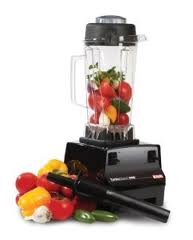
Vitamix® High-Performance Blender (3)

Nothing I tell you can come close to describing what a wonderful piece of machinery the Vitamix® blender is. You have kids and they do not like eating fruit? Toss everything in this blender (yes, even the healthy skin they will not eat in a billion years), push the button and in a few seconds, you will have the best smoothie ever. They will ask you for more!
You are a raw food eater? Perfect! Put all the ingredients to your favourite soup in the cup and Vitamix® will blend it to perfectness and warm it up for you, just right.
I Vitamix all my (boiled) soups because I like them smooth as silk. I could go on and on, but instead I invited you to take a look at their multi-lingual, video enhanced flashy Vitamix® website.
And in case you we wondering, no, I don't get any Vitamix® kick-backs! That machine and I is true love! Worth every penny!


Egg-Perfect® Egg Timer (4)


In my opinion, one of the most difficult things in life is to get an egg to boil to perfection. No matter which method I followed in the past, always a disaster. Eggs have different sizes, are kept at 'room temperature' or in the fridge and are inserted in to pans with other eggs (or not), in warm or cold water, in a big pan or small one and get covered to bring to boil...or not.
All of these factors will affect the way your egg turns out. Good grief! Too much variables for me!
When this timer came out, it saved my life!
The timer will allow you to make a 'soft', 'medium' or 'hard' boiled egg! How does it work? No idea... 


Kitchen Aid® Stand Mixer (5)


I know what you are thinking... I have a soft spot for expensive kitchen toys. Well, I kind of do! But this beauty is not just for looks. You like baking? Believe you me, you gotta have it! Shop around, buy it second hand, do what you have to. You will never regret it.
How else can you beat eggs, while at the same time adding some agave, then some salt, this or that to the mixture? I read some recipes and think... I know us women can multi-task but, what are we? Octopuses?
This machine will de-tress your baking life -and will look fab on your counter!


Measuring Spoons (6)


A no-brainer for many of you. But for those of you out there that do not live in North America, having a set of measuring spoons is not self explanatory.
Of course you could use 'regular' cutlery. But when precision is needed, you will be happy to have a  set of true measuring spoons at your finger tips!


Cast Iron Grill Pan (7)


I have seen this cast iron grill pan -or a similar version of it- in every country I have been to. This been said, not everybody had it as part of their kitchen inventory... This is why you should:
•I don't think there is a healthier way to grill your vegetables, fish and meat
•for sure there is no quicker way
•the finished product will taste as if it has been barbecued
•these pans are dirt cheap and will last you for literally, ever!


Measuring Cups (8)


If you are going to cook (or bake) out of a North American recipe, you want these measuring cups. I have tried it without them, for the sake of experiment. Looked up conversion tables thinking I could easily find the gram equivalent of, let's say, a cup of coconut flour. It is very tricky. Even if the websites out there do specify, liquids, volume, flour, etc. In my experience, nine times out of ten it will not be accurate. For volume it might work (let say, finding the equivalent in grams for a cup of carrots). But when it comes to measuring liquids or meals, forget it. Disaster is bound to happen.
Safe yourself some trouble and if the recipe calls for 'a cup of almond meal', take your measuring cup and be done with it. Not worth breaking your head over maths.


Oyster Knife (9)


The first time we tried opening oysters, my husband grabbed a regular knife. Needless to say, that didn't work -and almost ruined my kitchen knife!
Then he grabbed a screw driver... and a hammer. End result? He hurt his hand and broke the shells and although he did get those suckers open, his hand almost needed stitches and while we were able to sip our oysters, we had to crunch through the shells.
Obviously there had to be a better way to do this. At the time, there were no You Tube videos to show you the ropes; we learnt the hard way. But we did discover the oyster knife.
If you like oysters and even if you only treat yourself to some once a year, get the knife. It is totally worth it -an inexpensive version of it is very available.


Egg Poaching Pan (10)


I am sure it is possible to poach an egg without an egg poaching pan! I just don't know how to! I always make a mess of it. More so, if I attempt to poach more than 1 egg at a time.
They egg breaks, does not keep together, it is difficult to tell if it is done or not and more importantly, I find it quite difficult to drain the water, once I have managed to scoop it out of the pan in one go!
Since a poached egg is such a healthy choice, I invested in a poaching pan quite a while ago.
Worth every penny. In the UK and North America they are quite common -and inexpensive.
Travelling in the coming months? Put it on your shopping list!


Organic My Foot


Look up 'organic food', and you will find that 'organic standards' are set by national governments and international organizations and can vary quite a bit depending on where you live.
When it comes to animals, it does not necessarily mean it was able to live a free range life, pasturing the fields in the elements, was never vaccinated, given antibiotics or growth hormones. As far as vegetables, most governments allow 'certain types' of pesticides and fertilizers.

It might come to a surprise to you -or not- that from the research I have conducted so far, USDA 'approved organic' is a little more 'organic' than anywhere else in the world.

USDA: ... Organic agriculture practices cannot ensure that products are completely free of residues; however, methods are used to minimize pollution from air, soil and water(...) What is organic food? Organic food is produced by farmers who emphasize the use of renewable resources and the conservation of soil and water to enhance environmental quality for future generations.  Organic meat, poultry, eggs, and dairy products come from animals that are given no antibiotics or growth hormones.  Organic food is produced without using most conventional pesticides; fertilizers made with synthetic ingredients or sewage sludge; bioengineering; or ionizing radiation (...) 

Pretty good, I would say. The only thing is:
•we still do not know what these animals ate
•as far a the plants, we know they are produced without the use of 'conventional' pesticides and certain type of fertilizers. It would be interesting to see what the USDA understands under 'conventional' pesticides as opposed to 'non conventional' ones, and what kind of fertilizers they allow
•as far as I know, it does not regulate GMOs


The EEC legislation on organic food is a total joke. True to European unity, there is no unity:
(...)
Sustainable cultivation systems and a variety of high-quality products are the aim...Organic production must respect natural systems and cycles. Sustainable production should be achieved insofar as possible with the help of biological and mechanical production processes, through land-related production and without the use genetically modified organisms (GMO).
In organic farming, closed cycles with the use of the internal resources are preferred to open cycles with the supply of external resources. Ideally, external resources should be limited to organic resources from other organic farms, natural or naturally obtained materials and low soluble mineral fertilisers. In exceptional cases, however, chemical synthetic resources may be permitted if suitable alternatives are lacking. These are only authorised and listed in positive lists in the Annex of the Commission Regulation after a thorough investigation by the Commission and the Member States.
Since the European Union extends from the far North right down to Southern and into Eastern Europe, local climatic, cultural or structural differences can be compensated for through foreseen flexibility rules.
Foods may only be marked as "organic" if at least 95% of their agricultural ingredients are organic. Organic ingredients in non-organic food may be listed as organic in the list of ingredients, as long as this food has been produced in accordance with the organic legislation. In order to ensure better transparency, the code number of the control body must be indicated.
The use of genetically modified organisms (GMO) and of products manufactured from GMOs is still prohibited in organic production. Products containing GMOs may not be labelled as organic unless the ingredients containing GMOs entered the products unintentionally and the GMO proportion in the ingredient is less than 0.9%.
The Council Regulation applies to the following agricultural products, including aquaculture and yeast:
Living or unprocessed products
Processed foods
Animal feed
Seeds and propagating material
Collection of wild plants and seaweed is also included in the scope of this Regulation.
Multiple Annexes are attached to the Commission Regulation. Within these one can find the following:
Products permitted in organic farming, such as fertilisers, soil ameliorants and pesticides
Minimum requirements on the size of housing and exercise areas including pastures for organic livestock, depending on animal species and development stage.
Non-organic animal feed, feed additives and processing aids for the production of compound feed and premixtures permitted in organic farming
Non-organic ingredients, additives and processing aids permitted in organic food production (including yeast production).
(...)

•at first sight, the regulation seems very thorough...but oh boy, once you get to the multiple annexes and the flexibility they allow within each member state...you get sick to your stomach!

So are there any advantages at all to organic produce? Is it worth it paying top dollar? Loren Cordain remarks that the concentration of nitrate in organic produce is considerably lower than in fruits and vegetables that have been grown in conventional way. He also adds that studies demonstrate that organic produce shows reduced amounts of pesticides and toxic chemicals. "The environmental and dietary exposure to both pesticides and nitrates are associated with a greater risk for developing certain cancers", he writes (Cordain 2012:30-31).
I have to agree with Cordain: if cancer is of concern to you and if you can afford it, definitely go with organic!


Lifefood


Last month a friend told me about Lifefood products. She has recently 'converted' to a paleo diet and needed a 'crutch' to wean off the bread and crackers.
I am usually very suspicious of processed food, no matter how 'healthy' they appear to be at first sight. But knowing how thorough my friend M. can be, I just knew I needed to check it out.

I ordered their crackers and got a few 'energy bars' for free, to try out.

I inspected the products and I could not find anything not healthy about them:

•they are 100% raw
•they have no (added) sugar
•they contain no grains
•they have no dairy

The taste of the energy bar and of the crackers is amazing.

There are a couple of drawbacks:

•the products are German and so far, the only 'local' distributors are within the European Community. So shipping costs and possible import taxes for you living outside Europe, will add up
•the products themselves are not particularly cheep either. A box of crackers (85 g) will set you back approx. Euro. 4,25

My advise: wean off the bread as quickly as you can and don't use crutches. Treat yourself to Lifefood products on a special occasion!


Airplane Survival Kit

So, you are taking a trip by airplane.... You will need to prepare, because you will find absolutely nothing healthy, paleo, let alone organic on your tray.
Flying a North American airline? All the more reason to plan your meal(s)!

Here are a few ideas that will keep you in check, are easy to stash in your carry-on luggage and will pass security no problemo. Fill up your zip-locks and you are set to go!

  • a hard boiled egg;
  • smoked salmon (mackerel or eal)
  • a slice of Nutty Autumn Loaf 
  • a piece of cooked left-over fish or (game) meat
  • sliced fresh fruit
  • sliced carrots and cucumber
  • mixed nuts
  • dates, dried prunes and/or dried figs
  • + 70% dark chocolate

For flights to the USA, remember that the perishables you took with you and did not finish, will have to stay on board when you de-plane.


Blueberries

Blueberries are wonderful and because of their health benefits (they are high on anti-oxidants), you want to include them in every breakfast bowl!
They are more affordable at the end of the summer. My friend Janine tought me a simple method to 'hamster' them:

•wash the blueberries thoroughly (specially if they are not organic!);
•lay them down on a table cloth on your kitchen counter, well spread out (not on top of each other);
•when they are completely dry, put them on a tray (or Tupperware lid) and carefully slide them in your freezer (making sure they do not touch each other);
•within an hour (or less) they will be hard as a rock and completely frozen. You can now transfer them to a freezer zip-lock bag that will keep them fresh for months.

Sometimes (organic) farms will let you pick your own blueberries at the end of the summer (for a small price). Can you imagine a better way to spend a few hours in the fields and be in touch with nature? And just think of the thrill of picking your own fruit -and avoid the local store from plucking your wallet!
Look for farms in your neighbourhood.


De Wei (Lanaken, B)
Fruit of Life (Dwingeloo, NL)
Kwekerij Zeldenrust  (Wapse, NL)
Pur Fruit (Oeselgem, B)
Pampa Berries (La Pampa, Arg)
Pick-your-own (USA)


Tidbits


To me, quality and healthy goods are a top priority. But of course, I too like to be thrifty! I can imagine my suggestions may not always be helpful to everybody, since we all live in a variety of places, cities and continents. Still, I feel impelled to share all my tidbits, hoping to not only contribute to your health, but also to your pocketbook!